 Save Our Pak
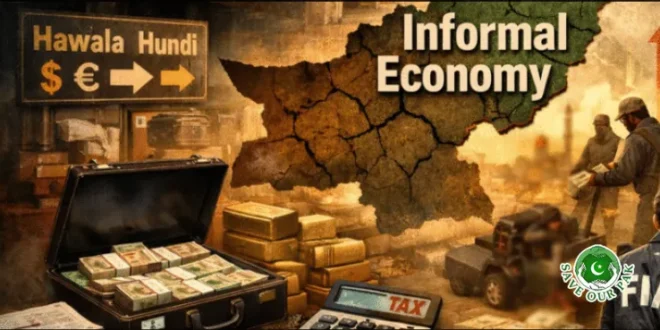
Pakistan’s informal economy has remained a serious and long-standing problem for many years. It continues to create major difficulties for the country’s tax system, financial control, and economic transparency. Millions of people and businesses operate outside the formal banking and documentation system. They rely on cash transactions, hundi and hawala networks, and unregistered businesses. Because of this, the government loses billions of rupees in tax revenue every year.
High inflation, unemployment, rising business costs, and a lack of trust in government systems are strengthening this informal setup. Weak monitoring and slow reforms are making the situation worse. Until the economy is properly documented, the tax system is made fair and simple, and public trust is restored, the informal economy will remain a major barrier to Pakistan’s economic growth.
At the end of the year, the Federal Investigation Agency (FIA) released a report highlighting strong action taken against illegal money activities. According to the report, authorities carried out 523 raids across the country, registered 546 cases, arrested 667 people, and completed investigations in 174 inquiries.
During these operations, currency worth more than Rs1.99 billion was recovered. This included about 777,868 US dollars, foreign currencies worth Rs320 million, and more than Rs1.45 billion in Pakistani rupees.
These figures reveal that illegal hundi and hawala networks are deeply rooted and well-organized in Pakistan. The large amount of seized money shows that the real scale of these illegal activities is likely much bigger than what has been caught.
The recovery of huge amounts of US dollars and other foreign currencies also shows that many people now consider foreign currency safer than the Pakistani rupee. Instead of using formal banking channels, demand for dollars is being met through illegal routes. This reflects continuing economic uncertainty, high inflation, and concerns about the weakening value of the rupee.
However, there is also a positive side to this development. The nationwide operations, arrests across all zones, sealing of markets and plazas, and cooperation among law enforcement agencies show that the state is now taking the issue more seriously. Under pressure from international bodies such as the IMF and FATF, the government appears determined to apply a zero-tolerance policy against financial crimes.
The data also shows that more arrests were made in Peshawar, Balochistan, and Karachi zones, indicating that currency smuggling remains more active in border areas. Informal financial networks linked to Afghanistan, Iran, and Gulf countries are still operating, creating both regional and international financial challenges for Pakistan.
Experts warn that unless the banking system becomes easier to use, the tax network becomes fairer, and the rupee is stabilized, hundi and hawala networks may rise again. Due to continued economic pressure and uncertainty, many people and businesses still choose informal channels instead of formal state systems.
Reported by Save Our Pak